Bridge the Gap in Resident Imaging Skills with a Simulated Case-Based Learning Solution

Modern diagnostic imaging has become the foundation of today’s healthcare. From CT and MRI to PET, SPECT, and ultrasound, these technologies allow clinicians to visualize anatomy and pathology in ways that were once unimaginable.
Each modality offers unique value—CT delivers precise structural detail, MRI captures soft-tissue and neurological insights, PET and SPECT reveal metabolic activity, and ultrasound enables real-time, dynamic imaging. Together, they have transformed diagnosis, treatment, and patient outcomes.1
As imaging capabilities continue to advance, so do expectations for clinicians. Every specialty now relies on imaging to guide decision-making, making it essential for physicians—not just radiologists—to know how to select, interpret, and apply these studies effectively. But this growing need for imaging competence comes at a challenging time.
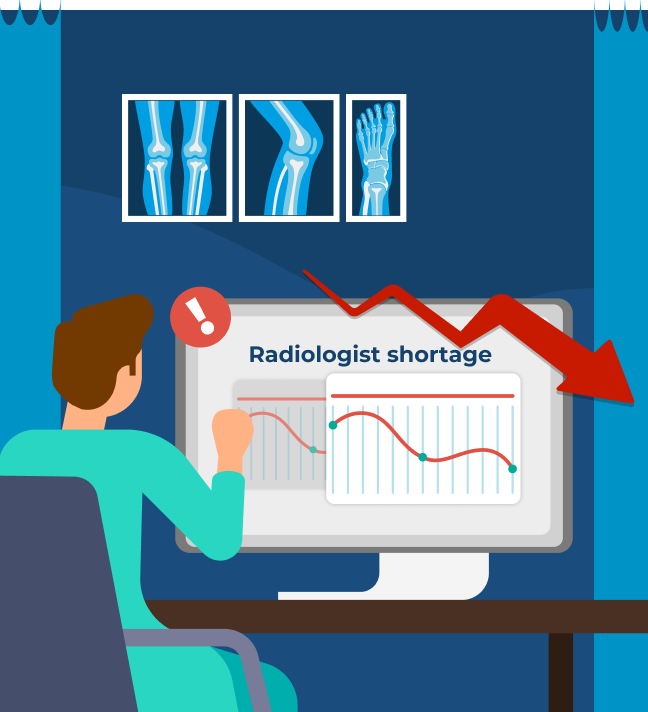
The United States faces a nationwide radiologist shortage fueled by an aging population, increased imaging demand, and limited training capacity. This imbalance affects more than workflow—it directly impacts medical education by reducing opportunities for residents to gain hands-on experience and mentorship in imaging interpretation.2
In this article, we’ll explore:
- The challenges in graduate medical education that contribute to imaging competency gaps across non-radiology specialties.
- The solution to help medical programs strengthen residents’ diagnostic confidence through scalable, case-based imaging education.
As imaging grows more integral to every area of medicine, many programs are finding it difficult to keep pace.
The Imaging Training Challenges in Graduate Medical Education
Despite widespread recognition of the importance of imaging competence, many graduate medical education programs continue to face systemic gaps in training. Program directors across core specialties report that residents often enter their programs with limited confidence in interpreting and applying imaging findings in clinical practice. These gaps are compounded by inconsistent exposure, fragmented curricula, and a lack of standardized learning objectives—leaving residents with varying levels of preparedness for image-based decision-making.
While the nature of these challenges varies across disciplines, a consistent theme emerges: imaging education remains underdeveloped in many non-radiology residencies. Here’s how this gap presents across several key specialties.
Neurology
In neurology residency programs, imaging competence is a cornerstone of clinical decision-making—particularly in acute care, where timely interpretation can change outcomes. Yet, despite the clear importance of neuroimaging, training remains inconsistent.
Recent findings show wide variability in the structure and delivery of neuroradiology education, with differences in rotation length, exposure to modalities, and assessment methods across programs.3 Residents often report limited face-to-face time with neuroradiologists and uneven opportunities to interpret cases independently. Many also express lower confidence in interpreting advanced modalities like spine MRI, cerebral perfusion scans, and Doppler ultrasound.
Time constraints, a shortage of educators, and a lack of standardized learning objectives continue to be cited as major barriers, underscoring the need for more structured, competency-based neuroradiology training that aligns with modern neurologic care.

Emergency Medicine
In emergency medicine, where rapid interpretation of imaging often guides life-saving decisions, radiology training remains highly inconsistent. Many programs lack formal imaging curricula, relying instead on limited didactic sessions or informal bedside teaching.4 Few offer dedicated radiology rotations or structured assessments, leaving residents with only a few hours per month of imaging instruction.
Although nearly all educators agree that skills such as interpreting chest or musculoskeletal radiographs are critical for practice, training time and exposure vary widely. These gaps leave many residents underprepared to independently interpret essential studies in high-pressure clinical environments, underscoring the need for more standardized imaging education within EM programs.
Internal Medicine
For internal medicine residents, point-of-care ultrasound (POCUS) has become an essential diagnostic skill, yet training in this area remains fragmented. Many programs still rely on one-time workshops or limited procedural instruction, despite evidence showing that these approaches fail to sustain long-term retention.5
Without continuous, structured ultrasound education, residents’ ability to identify key findings—such as pleural effusions, ascites, and vascular anatomy—declines significantly over time. Programs that incorporate longitudinal, hands-on ultrasound curricula see stronger knowledge retention and diagnostic confidence, highlighting the need for consistent, competency-based imaging education throughout internal medicine training.6
Family Medicine
In family medicine, imaging skills are increasingly vital for comprehensive patient management, yet gaps in competency persist across programs. Research shows that fewer than half of family medicine residents accurately interpret key emergency chest X-ray findings such as pneumomediastinum or lobar collapse, achieving an overall diagnostic accuracy of just 58%—significantly lower than radiology trainees. 7
Notably, only one in four residents reported receiving adequate training in chest X-ray interpretation, underscoring the uneven emphasis placed on imaging education across programs. Similar disparities exist in ultrasound training, where limited curricular integration and lack of faculty expertise remain key barriers to proficiency. 8
These findings highlight an urgent need for structured, longitudinal imaging education within family medicine residencies to strengthen diagnostic accuracy and clinical confidence.
Pediatrics
In pediatric residency programs, exposure to imaging—particularly point-of-care ultrasound (POCUS)—remains limited despite its growing role in inpatient and acute care. Across the United States, only a small portion of pediatric hospital medicine divisions currently incorporate structured POCUS education into training.9
The most common challenges include limited access to trained faculty, insufficient equipment, and financial barriers that prevent broader implementation. Without consistent, hands-on instruction, many pediatric residents graduate with uneven imaging experience and reduced confidence in using ultrasound to guide diagnosis and care.
OB/GYN
Ultrasound has become central to obstetric and gynecologic practice, yet training in this critical imaging modality remains highly variable across residency programs. Many programs face limited instructional time and inconsistent opportunities for residents to build hands-on competency.10
Current evidence points to a lack of standardized curricula and assessment frameworks, resulting in uneven skill development across trainees.11 To close these gaps, leading professional organizations now emphasize structured, competency-based ultrasound education that incorporates simulation and guided image review—approaches shown to strengthen confidence, improve diagnostic accuracy, and prepare residents for independent practice.
Anesthesiology
In anesthesiology, point-of-care ultrasound (POCUS) has become essential for procedures such as vascular access, regional anesthesia, and perioperative assessment—yet training across residency programs remains inconsistent. Many programs lack structured curricula or formal competency assessments, even as ultrasound skills are now required for certification and practice.12
Common barriers include limited faculty expertise, insufficient resident training time, and constrained institutional resources. Despite widespread recognition of its value, fewer than half of programs provide comprehensive, longitudinal ultrasound education, and most rely on informal bedside instruction.
These disparities underscore the ongoing need for standardized, competency-based imaging education in anesthesiology residencies to ensure consistent proficiency in this critical skill set.
Surgery
In surgical education, imaging plays a vital role in diagnosis, procedural planning, and intraoperative decision-making. Yet, despite its clinical importance, residency programs continue to face long-standing challenges in maintaining consistent, competency-based training. Many of the issues identified more than a decade ago—such as variability in operative exposure, limited resident autonomy, and gaps in standardized assessment—remain prevalent today.13
Recent findings reveal that these challenges persist globally, with over half of general surgery residents reporting insufficient theoretical and practical training, limited academic support, and a lack of curricular standardization across programs.14
These gaps underscore the continued need for structured, longitudinal learning experiences that integrate imaging and diagnostic reasoning into surgical education.
Across specialties, imaging has become a vital component of clinical decision-making, yet residency training in this area remains inconsistent and underdeveloped. Many programs continue to face challenges in providing structured, competency-based instruction that keeps pace with the increasing use of diagnostic imaging in patient care.
Bridging these gaps requires more than traditional didactics or isolated rotations—it calls for a modern, technology-enhanced approach that allows residents to practice, apply, and build diagnostic confidence through active learning.
The Solution to Help Programs Elevate Residents’ Imaging Skills
The pervasive gaps in non-radiology imaging education—namely, the lack of standardization, limited foundational knowledge among junior residents, and the logistical difficulty of maintaining competency over time—require a modern, technology-enhanced approach. Medality, an imaging practice development platform, offers a scalable solution that directly addresses these structural deficits.
Medality provides a simulated, case-based learning experience that helps radiologists and non-radiologist clinicians from top academic programs and practices worldwide strengthen their imaging interpretation and diagnostic reasoning skills. Its platform spans all major subspecialties and modalities, featuring an extensive microlearning library of expert-led videos, interactive lectures, and scrollable DICOM cases that mirror real-world clinical practice.
Through its partnership with TrueLearn, Medality brings simulated, case-based imaging education to programs seeking to enhance diagnostic training and competency development. This collaboration enables program leaders to track resident progress, identify performance gaps, and deliver consistent, data-informed imaging instruction across the curriculum. The result is a more personalized and measurable approach to residency education—one that reinforces critical thinking and bridges the gap between theoretical knowledge and applied clinical skill.
For residency programs, Medality serves as a comprehensive supplement to existing curricula, helping to:
- Supplement imaging curricula to enhance or fill voids in rotations or didactics
- Address facetime gaps with radiologists and imaging specialists
- Increased education quality and resident satisfaction for their desired learning needs
1 Hussain S, Mubeen I, Ullah N, et al. Modern diagnostic imaging technique applications and risk factors in the medical field: A review. Biomed Res Int. 2022;2022(1):5164970. doi:10.1155/2022/5164970
2 Afshari Mirak S, Tirumani SH, Ramaiya N, Mohamed I. The growing nationwide radiologist shortage: Current opportunities and ongoing challenges for international medical graduate radiologists. Radiology. 2025;314(3):e232625. doi:10.1148/radiol.232625
3 Benea D, Di Ioia R, Bejjani J, et al. Education research: Neuroradiology curriculum and competencies among Canadian adult neurology residency programs: A cross-sectional study: A cross-sectional study. Neurol Educ. 2023;2(4):e200096. doi:10.1212/NE9.0000000000200096
4 Villa SE, Wheaton N, Lai S, Jordan J. Radiology education among emergency medicine residencies: A national needs assessment. West J Emerg Med. 2021;22(5):1110-1116. doi:10.5811/westjem.2021.6.52470
5 Kelm DJ, Ratelle JT, Azeem N, et al. Longitudinal ultrasound curriculum improves long-term retention among internal medicine residents. J Grad Med Educ. 2015;7(3):454-457. doi:10.4300/JGME-14-00284.1
6 Faiella W, Tran A, Houston S, et al. Implementation of a longitudinal POCUS curriculum in the core internal medicine residency program at Dalhousie University. Can J Gen Intern Med. 2021;16(3):27-39. doi:10.22374/cjgim.v16i3.482
7Al Shammari M, Hassan A, AlShamlan N, et al. Family medicine residents’ skill levels in emergency chest X-ray interpretation. BMC Fam Pract. 2021;22(1):39. doi:10.1186/s12875-021-01390-3
8 Hall JWW, Holman H, Barreto TW, et al. Point-of-care ultrasound in family medicine residencies 5-year update: A CERA study. Fam Med. 2020;52(7):505-511. doi:10.22454/FamMed.2020.223648
9 Weinberger K, Rocha MEM, Keough C, et al. Point-of-care ultrasound in pediatric hospital medicine: A national survey. Hosp Pediatr. 2025;15(8):686-692. doi:10.1542/hpeds.2024-008287
10 Matschl J, Jimenez-Cruz J, Schäfer VS, et al. Current status of ultrasound training in obstetrics and gynecology: a scoping literature review. Front Med (Lausanne). 2024;11:1426484. doi:10.3389/fmed.2024.1426484
11 Abuhamad A, Minton KK, Benson CB, et al. Obstetric and gynecologic ultrasound curriculum and competency assessment in residency training programs: consensus report. Ultrasound Obstet Gynecol. 2018;51(1):150-155. doi:10.1002/uog.18967
12 Edwards J, Ahn D, Alcaraz D, et al. Point-of-care ultrasound training among anesthesiology residency programs in the United States. BMC Anesthesiol. 2025;25(1):105. doi:10.1186/s12871-025-02929-y
13 Klingensmith ME, Lewis FR. General surgery residency training issues. Adv Surg. 2013;47:251-270. doi:10.1016/j.yasu.2013.05.001
14 Kıvratma HG, Yavuz B, Çağ MC, et al. Exploring the perspectives and challenges of general surgery residents in Türkiye: Insights from a survey on surgical training. Turk J Surg. 2025;41(2):121-129. doi:10.47717/turkjsurg.2025.6783

 Educator Blog
 Educator Guide