
Integrating PT Board Prep into Curriculum Early Enhances Students’ Exam Readiness

Physical therapy (PT) programs face increasing pressure to ensure students are fully prepared for the National Physical Therapy Examination® (NPTE®). As expectations for first-time pass rates continue to rise, educators are turning to more effective, data-informed strategies to support student success.
For many students, preparing for the NPTE® can be overwhelming. With a vast amount of content to cover and limited clarity on where to focus, students often rely on last-minute review sessions and intensive practice exams. While these end-of-program efforts may benefit some, they tend to fall short for those who have struggled throughout the curriculum—and can contribute to stress, burnout, and poor retention.
A more sustainable and impactful approach is to integrate PT board prep into the curriculum early and consistently. By embedding board-style questions and assessments into lectures, assignments, and coursework across the academic journey, faculty can monitor performance over time, identify learning gaps early, and provide targeted support before students fall behind.
In this article, we will explore:
- Research-backed evidence supporting the use of board prep tools to improve NPTE® outcomes.
- How TrueLearn and Picmonic support curriculum alignment, remediation, and exam readiness.
Discover how cognitive science and data analytics can transform your curriculum and improve NPTE® outcomes.
Discover how cognitive science and data analytics can transform your curriculum and improve NPTE® outcomes.
What Research Says About Integrating PT Board Prep into Curriculum
There is growing evidence that integrating PT board prep into the curriculum early and consistently leads to better student outcomes. Rather than relying on high-stakes practice exams or intensive review sessions at the end of the program, physical therapy educators are seeing the benefits of a longitudinal approach—embedding board prep resources across the entire academic experience.
Recent research highlights the predictive power of academic indicators such as GPA, mid-program assessments, and course exam scores. These metrics strongly correlate with NPTE® performance and can help faculty proactively identify students who may need additional support. This data-informed approach gives programs the insight needed to tailor remediation strategies well before graduation.
Incorporating board-style questions and assessments into coursework not only reinforces content but also improves students’ test-taking skills and retention. With regular exposure to NPTE®-aligned material, students are more confident and prepared—not just academically, but mentally—for exam day. This shift reduces reliance on last-minute cramming, which often leads to stress and burnout.
Evidence also supports the impact of individualized interventions. In one case, students who received predicted NPTE® scores based on their academic performance—along with targeted faculty advising—scored nearly 26 points higher on average and were five times more likely to pass on their first attempt. These outcomes were achieved using tools already available within the program, demonstrating that meaningful gains don’t require major curricular overhauls—just smarter integration.
While many programs rely heavily on clinical performance assessment tools (CPATs) to measure student readiness, a recent systematic review revealed wide inconsistencies in their reliability, validity, and educational impact. No CPAT scored above a Level C evidence rating, highlighting a critical gap in how programs assess clinical competence. Embedding structured board prep throughout the academic curriculum helps fill this gap by offering measurable, standardized content that better reflects what students will face on the licensure exam.
For faculty, integrating PT board prep into the curriculum also provides long-term benefits. Longitudinal data enables educators to uncover patterns across cohorts, improve instructional design, and ensure alignment between academic preparation and NPTE® expectations. This proactive model creates a more responsive, outcomes-driven learning environment.
The takeaway is clear: when PT programs treat board prep as an ongoing part of the learning journey—not a one-time event—students are more prepared, faculty are more informed, and NPTE® success becomes a more consistent, achievable goal.
By embedding board prep throughout the curriculum, programs can better support student success while gaining valuable insight into performance trends. The right tools can make this process seamless—for both students and faculty.
So how do these tools deliver on those outcomes?
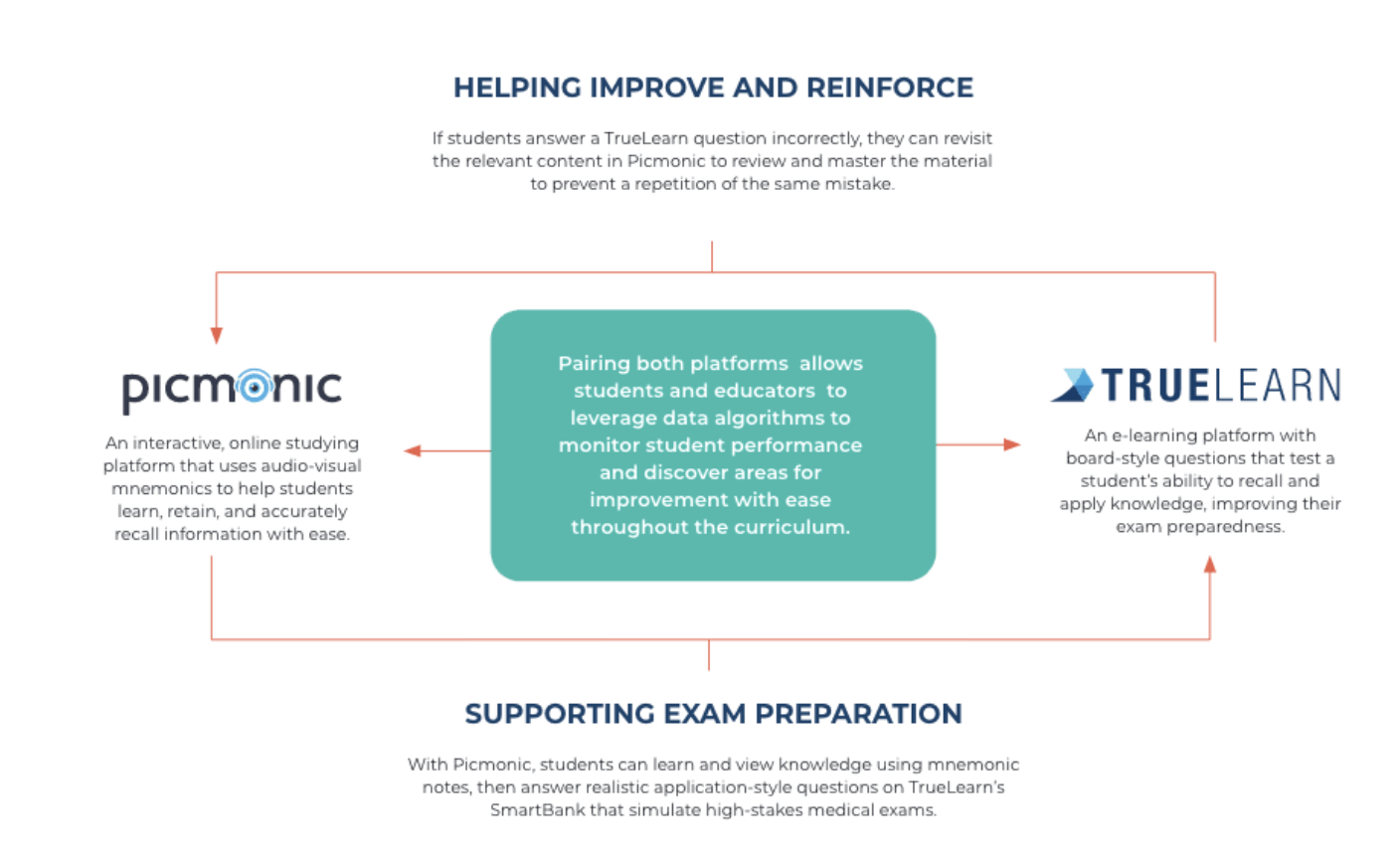
How TrueLearn and Picmonic Support Curriculum to Drive NPTE® Readiness
By leveraging a data-driven precision learning platform like TrueLearn and an audiovisual mnemonic system like Picmonic, physical therapy programs can enhance instruction, reinforce retention, and strengthen exam readiness. When implemented together, these tools integrate seamlessly into the curriculum—helping educators track performance trends and enabling students to build lasting mastery of board-relevant content.
Comprehensive curriculum and board review
TrueLearn and Picmonic empower students to complete a comprehensive, structured review of the full physical therapy curriculum—from anatomy and physiology to biomechanics and clinical decision-making. Both platforms are aligned with NPTE® content areas, ensuring consistent exposure to high-yield material throughout the program.
Picmonic reinforces key concepts using spaced repetition, prompting learners to revisit information at optimal intervals to improve long-term retention and overcome the forgetting curve. TrueLearn’s board-style quizzes and mock assessments simulate the NPTE® testing experience, building students’ test-taking confidence and reducing exam-day anxiety. Together, these tools support deeper understanding, more effective preparation, and higher first-time pass rates.
Personalized and Data-Driven Learning
TrueLearn’s NPTE SmartBank uses adaptive learning technology to tailor the study experience to each student’s strengths and weaknesses. Through low-stakes recall and targeted questions, students build readiness for high-stakes testing while identifying areas for improvement.
The performance data generated by these assessments gives faculty real-time insight into knowledge gaps at both the individual and cohort level. This enables early, targeted remediation and differentiated instruction. For students, it means more efficient studying, improved focus, and better time management—especially as they balance the demands of a rigorous academic program.
More Active and Engaged Learners
These tools also promote active learning through engaging, multimodal content. Picmonic transforms complex PT concepts into vivid, memorable stories using visuals, audio, and storytelling elements. These cues activate multiple areas of the brain, helping students form strong memory connections and retain information longer.
Combined with TrueLearn’s detailed explanations and AI ChatBot that helps learners turn review time into precision learning with personalized explanations, summaries, and clarifications provided instantly, students receive immediate feedback, allowing them to engage more deeply with the material rather than relying on passive review.
This dynamic approach builds conceptual mastery and strengthens critical thinking skills—leading to more confident, competent future clinicians.
Embedding PT board prep into the curriculum from the start creates a stronger foundation for student success—academically and clinically. With TrueLearn and Picmonic, programs gain a curriculum-aligned solution that reinforces key concepts, supports targeted remediation, and promotes long-term retention. The result: better-prepared students, improved NPTE® performance, and a more data-informed approach to teaching and learning.
NPTE® is a trademark of Federation of State Boards of Physical Therapy (FSBPT®).
This content is not endorsed or approved by Federation of State Boards of Physical Therapy (FSBPT®).

 Educator Whitepaper
 Educator Guide
 Educator Blog